About the Gopher-to-Badger High-Voltage Transmission Line Project
Overview
| Key Fact | Detail |
|---|---|
| Project Name | Gopher to Badger Link — MariBell Segment |
| Voltage | 765 kilovolts (kV) — the highest voltage ever proposed in the Upper Midwest |
| Tower Height | Up to 200 feet — taller than a 15-story building |
| Right-of-Way Width | 250 feet of permanently cleared land |
| Length (MN segment) | Approximately 140 miles through Southeast Minnesota |
| Estimated Cost | $821 million (Minnesota portion, 2024 dollars) |
| Developers | Dairyland Power Cooperative and GridLiance Heartland |
| Regulatory Decision | Expected 2027 (Minnesota Public Utilities Commission) |
| Projected In-Service Date | 2034 |
| Local Electricity Benefit | None — power passes through Southeast Minnesota to eastern markets |
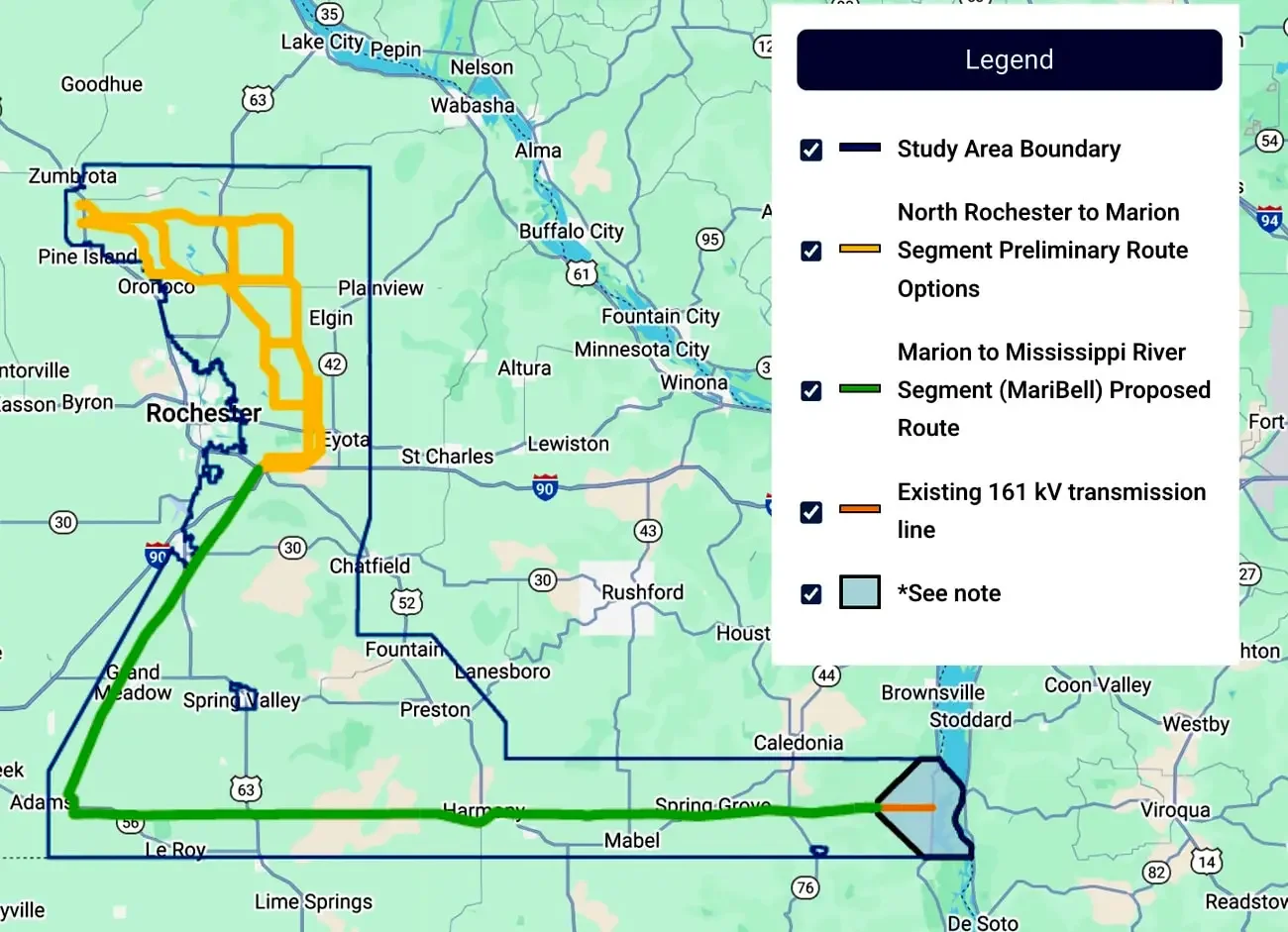
A map of the proposed Maribel section route.
A Power Line for Someone Else
Imagine waking up one morning to find that utility companies have proposed running a line of 200-foot steel towers across your family's farm — towers taller than a 15-story building, spaced every quarter mile, cutting a 250-foot-wide cleared swath through fields your grandparents broke. Now imagine being told the electricity those towers carry won't power a single home in your county. It's just passing through.
That's the reality facing farmers and landowners in Southeast Minnesota's Driftless region, where Dairyland Power Cooperative and its partner GridLiance Heartland are seeking approval to build the MariBell segment of the "Gopher to Badger" 765-kilovolt transmission line — one of the largest high-voltage power projects ever proposed in the United States.
What Is the Gopher to Badger Line?
The Gopher to Badger Link is a proposed high-voltage transmission corridor stretching from the western Minnesota prairie to Bell Center, Wisconsin — roughly 175 miles in total. It's part of a sweeping regional grid expansion plan developed by MISO, the Midcontinent Independent System Operator, designed to move large volumes of electricity generated by wind farms in the Dakotas and western Minnesota eastward to population centers.
The MariBell segment — the portion that would cross Southeast Minnesota — is approximately 140 miles long. It would replace an existing, much smaller 161-kilovolt line with a massive new 765-kilovolt double-circuit configuration requiring towers up to 200 feet tall with a right-of-way corridor 250 feet wide. The estimated cost for the Minnesota portion alone is $821 million. The line is not expected to be in service until 2034, and the Minnesota Public Utilities Commission won't make a final decision until at least 2027.
Why This Region?
Southeast Minnesota's Driftless Area is unlike anywhere else in the Midwest. Because glaciers never covered it during the last Ice Age, the land was carved instead by tens of thousands of years of wind and water into a dramatic landscape of steep bluffs, clear cold-water streams, and deeply carved river valleys. It's home to some of the best trout fishing in the country, a critical flyway for migratory birds including eagles, and a patchwork of multi-generational family farms that have been in the same families for a century or more.
Beneath the surface, the region is equally unique — and fragile. The underlying limestone bedrock is riddled with sinkholes, caves, and underground passages, a geology known as karst. Rainwater moves rapidly through these hidden channels directly into groundwater, meaning contamination from surface activity — including construction — can reach wells and streams almost instantly, bypassing the normal filtration that soil provides. Fillmore County alone has more than 10,000 documented sinkholes.
This is the landscape the proposed towers would be anchored into, requiring deep foundations drilled into bedrock that, in many places, conceals invisible voids. Engineers who have studied transmission tower foundations in karst terrain have documented cases where hidden underground cavities caused structural tilt and, in some cases, failure.
The Case Against It
The coalition opposing the MariBell line isn't simply saying "not in my backyard." They're raising substantive questions that deserve answers before any permits are granted.
First, need: MISO's projections for why this line is necessary are based on energy demand forecasts extending 40 years into the future, factoring in speculative growth from data centers and artificial intelligence. Opponents argue these projections deserve rigorous independent scrutiny before a permanent industrial corridor is imposed on private land.
Second, alternatives: utilities have largely dismissed the idea of burying the line underground, citing costs four to ten times higher than overhead construction. But opponents point to advances in underground high-voltage direct current (HVDC) technology that have been successfully deployed in other states, and to grid-enhancing technologies that could squeeze more capacity out of existing lines without building new ones. These alternatives, they argue, haven't been given a fair hearing.
Third, process: many landowners say they were not meaningfully informed before easement paperwork began circulating — in some cases, documents were presented in ways that obscured their full implications. Minnesota law requires that easement agreements be made clearly and in good faith. Landowners who feel that standard wasn't met have grounds to challenge what they signed.
What Landowners Can Do
Minnesota has stronger landowner protections than most states when it comes to high-voltage transmission lines. The state's "Buy the Farm" law — enacted in 1977 after farmers pushed back against earlier transmission projects — gives agricultural landowners the right to require a utility to purchase their entire farm, not just the strip of land the line crosses, if the line is forced onto their property through eminent domain. The Minnesota Supreme Court has affirmed that this right is absolute: a court cannot second-guess a landowner's decision to invoke it.
Beyond that, landowners have the right to participate formally in the Minnesota Public Utilities Commission process — not just by submitting a comment, but by intervening as a legal party with the ability to request information, present expert testimony, and cross-examine utility witnesses. NO765MN and the North Route Group have already filed petitions to intervene in the regulatory dockets.
You're Not Alone
Communities across the country are fighting similar battles. In Wisconsin, the Cardinal-Hickory Creek line — a smaller 345-kilovolt project that also crossed the Driftless Area — faced years of legal challenges over environmental impacts and process fairness. In Texas, rural landowners are currently opposing a 765-kilovolt line through the Hill Country, raising the same concerns about karst geology and the lack of local benefit. In Kansas and Illinois, the Grain Belt Express project spent more than a decade in legal proceedings before moving forward.
These fights are long and hard. But they have shaped outcomes — forcing route changes, stronger environmental reviews, and better landowner protections. The regulatory process for the MariBell line is still in its early stages. There is time to be heard.