A Shock to the System: Retired Cardiologist Demands 3.1-Mile Safety Buffer in Minnesota 765 kV High-Voltage Grid Battle
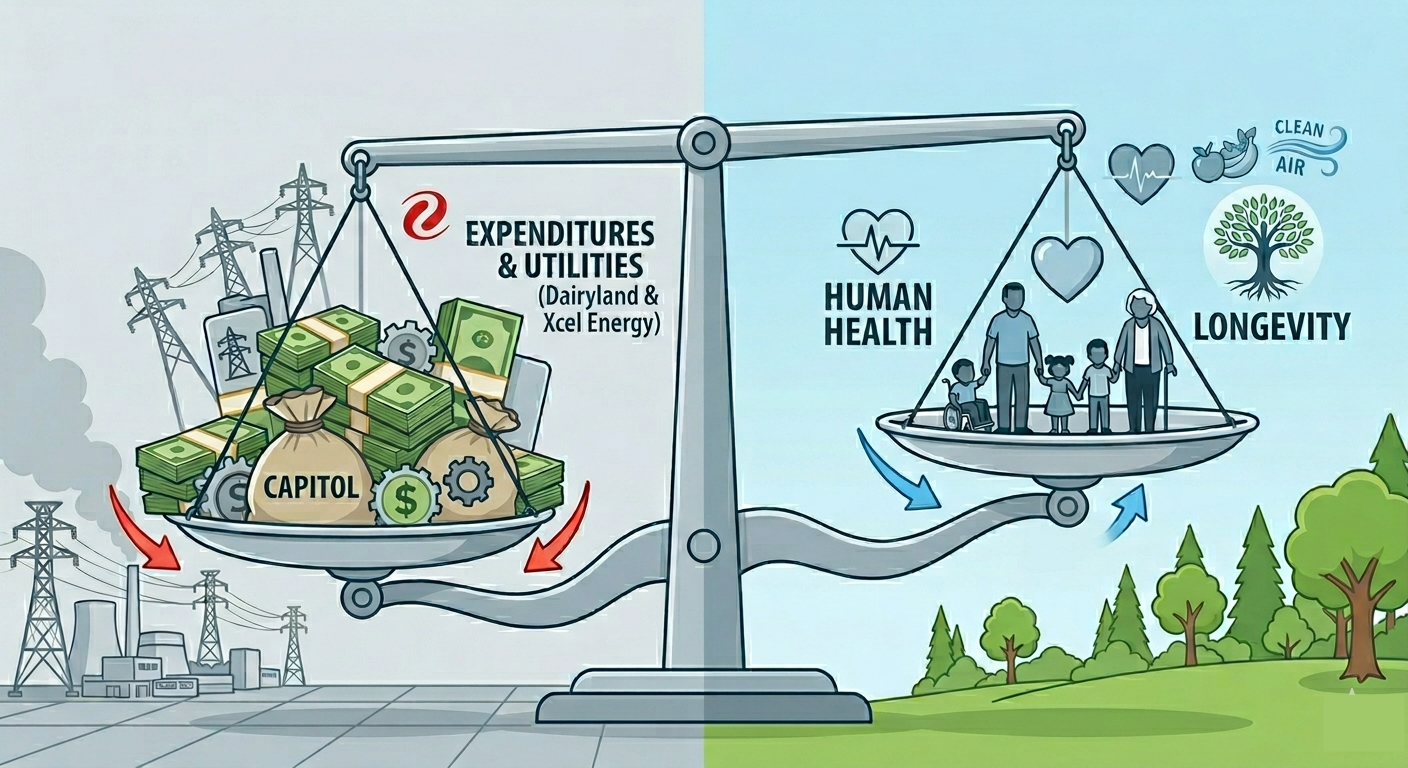
The Social Dividend: Weighing Utility Capital Expenditures Against Human Longevity
ST. PAUL, MN — A high-stakes regulatory battle is brewing before the Minnesota Public Utilities Commission (MnPUC) over Xcel Energy and Dairyland Power’s proposed 765 kV Transmission Line Project. In a comprehensive scientific rebuttal filed on May 20, 2026, Dr. W. Ben Johnson, MD, FACC, has fundamentally challenged the safety protocols of the overhead high-voltage corridor planned for Minnesota and Wisconsin.
Dr. Johnson—a retired cardiologist, adult cardiac electrophysiologist, and former Institutional Review Board (IRB) Chair—argues that the project represents an unmonitored human experiment that ignores modern molecular biology and medical hardware limits. As an affected landowner, he is demanding that regulators mandate either a 3.1-mile (5 km) biological safety setback or force the utility to bury the line underground using advanced grid technologies.
The Regulatory Deficit: Hiding a "Tsunami" Behind a Mist
At the heart of the dispute is a massive scientific disconnect between utility compliance metrics and modern environmental medicine. Dr. Johnson’s brief levels a scathing critique against the industry's reliance on the U.S. Environmental Protection Agency’s (EPA) 1974 "Levels Document".
According to the filing, this framework is entirely obsolete due to several structural blind spots:
The ONAC Vacuum: In 1982, the federal government completely defunded the EPA's Office of Noise Abatement and Control (ONAC). While the Noise Control Act of 1972 remained on the books, it became an empty statutory shell with zero enforcement capacity. Utilities have effectively used this 44-year vacuum to present outdated, half-century-old guidelines as modern safety approvals.
The Deception of Averaging (Leq): Utility applicants rely on time-integrated 24-hour sound averages to prove compliance. Dr. Johnson argues this is a mathematical trick that treats a continuous, day-long gentle acoustic "mist" identical to a sudden, violent 1-minute "tsunami". Human physiology does not respond to mathematical means; it responds to peak kinetic pressure wavefronts (Lpeak).
The Non-Lemniscal Trap: While standard traffic noise travels through the classical lemniscal auditory pathway and allows the brain to habituate, the chaotic, high-amplitude "sizzling" and "crackling" of transmission line noise (TLN) routes directly through the primitive, non-lemniscal pathway. This survival center (the amygdala and hypothalamus) is structurally incapable of tuning out erratic stimuli, trapping residents in a permanent, subconscious fight-or-flight loop.
Sub-Cellular Warfare: Mechanotransduction and Cellular Leaks
Moving far beyond traditional arguments about rural viewsheds and property devaluation, the brief introduces a sophisticated pathogenetic model centered on mechanotransduction—the process by which human cells translate external physical pressure waves into internal biochemical signals.
When a 765 kV line experiences "corona discharge" (the high-voltage ionization of ambient air), it projects an unweighted 75.1 dBZ linear continuous energy floor and a 90.1 dB Lpeak physical wavefront. Dr. Johnson explains that this acts as a relentless acoustic piston that penetrates deep into internal human tissues, triggering severe cellular disruption:
The Endothelial Destruction Cascade
In a normal state, endothelial cells lining the circulatory system sense clean fluid shear stress and produce Nitric Oxide (NO) to dilate blood vessels and maintain healthy blood pressure. However, the continuous 120 Hz kinetic "hammering" of the 765 kV line forces open specialized mechanosensitive ion channel arrays known as PIEZO1 and TRPV4.
This causes a chaotic, unregulated flooding of intracellular Calcium (Ca2+). This calcium overload forces mitochondria to overproduce Reactive Oxygen Species (ROS)—specifically superoxide radicals—which instantly "mop up" vital Nitric Oxide. Deprived of NO, blood vessels remain chronically constricted, leading directly to endothelial dysfunction, baseline hypertension, and accelerated coronary artery disease.
Epigenetic "Time Capsules"
The brief warns that this chronic environmental bombardment eventually rewrites human biology without changing the underlying DNA sequence. The continuous stress hormone surges execute widespread DNA methylation, specifically locking down the NR3C1 glucocorticoid receptor gene promoter. This molecular "tag" blunts the body's ability to shut off its fight-or-flight response, trapping residents in permanent sympathetic stress.
Worse, the brief highlights that these acquired epigenetic marks are heritable across generations, meaning children born to mothers residing within the exposure zone inherit a pre-primed, hyper-reactive stress axis.
To ground these molecular mechanisms in real-world data, Dr. Johnson cites major epidemiological benchmarks:
The Mainz 2026 Clinical Trial: Documented a statistically overwhelming 20% to 69% surge in new-onset heart failure and life-threatening arrhythmias (p<0.0001) in populations exposed to persistent, non-habituating low-frequency noise stressors.
The Zurich Airport Study (Saucy et al., 2021): Proved that nighttime noise transients act as immediate triggers for acute plaque rupture and fatal myocardial infarctions, escalating mortality risks by up to 44%.
The Asanova & Rakov Worker Cohort (1966): A landmark longitudinal study of Soviet high-voltage substation workers showing that chronic, non-thermal exposure to early 500 kV lines caused deep neurovascular headaches, severe sleep fragmentation, and microvascular compromise that caused a "near-synchronous" loss of sexual vigor in 30% of the cohort.
Medical Implant Jamming: The Hardware Danger Zone
For patients relying on Cardiac Implantable Electronic Devices (CIEDs), such as pacemakers and implantable cardioverter-defibrillators (ICDs), the overhead corridor represents an immediate physical hazard. Global medical hardware standards (ANSI/AAMI/ISO 14117) mandate an absolute upper design immunity ceiling of 6.0 kV/m for power-frequency electric fields.
However, a 765 kV transmission line operating at peak capacity projects an unshielded 10.0 to 12.0 kV/m electric field directly under its centerline.
Standing within this unmarked right-of-way can overwhelm a device's noise-rejection filters through constructive superposition. This can blind input sensors, tricking pacemakers into skipping vital beats (pacing inhibition), causing catastrophic lead-tip thermal tissue necrosis, or prompting ICDs to deliver painful, maximum-energy internal shocks to conscious patients for "virtual" ventricular fibrillation. Because the utility's right-of-way lacks fences or warning signs, Dr. Johnson classifies it as a classic "deceptively innocent property hazard".
The Proposed Remedy: A 3.1-Mile Setback or Underground Burial
Dr. Johnson's filing presents the MnPUC with a clear "Hard Look" decision matrix under the Administrative Procedure Act (APA), noting that authorizing the current overhead design on a blank safety record would constitute a fatal, reversible legal error.
THE APA DECISION MATRIX
THE COMPLIANCE REGULATORY PATH
• Relies on static 24-hr Leq
• Evaluates fields in isolation
• Ignores implant safety ceilings
APA STATUS: REVERSIBLE ERROR
(Ruling: Arbitrary & Capricious)
THE MANDATORY CLINICAL PATH
• Tracks peak kinetic energy (Lpeak)
• Addresses constructive superposition
• Enforces ISO 14117 safeguards
APA STATUS: LEGALLY SOUND
(Ruling: Defensible Protection)
To resolve this biological crisis, the intervention demands the execution of specific regulatory reliefs:
1. The 3.1-Mile (5 km) Safety Setback
The brief establishes a mandatory 3.1-mile safety horizon derived from a highly conservative 6 dB per doubling of distance decay model. This is the absolute mathematical convergence point where the line's impulsive noise transients safely decay below the 40 dB exterior facade ceiling mandated by World Health Organization (WHO) Night Noise Guidelines to preserve a restorative 25 dBA indoor bedroom environment. Simultaneously, this distance drops the 120 Hz acoustic piston below the 40 dB unweighted cellular threshold, successfully closing the TRPV4 calcium gates.
2. The Underground Burial Mandate
If a 3.1-mile geographical buffer is impossible, the commission must mandate that the line be buried underground using High-Voltage Direct Current (HVDC) architecture. Dr. Johnson notes that undergrounding operates as a complete physical cure: it prevents air ionization entirely (eliminating corona noise at the source), absorbs mechanical vibrations through the earth, and fully contains the massive 12.0 kV/m electric field within a secure boundary measured in feet rather than miles.
3. Advanced Grid Alternatives (Preventive Engineering)
The brief points out that building a massive, greenfield 765 kV overhead corridor is an obsolete 1970s utility approach. Dr. Johnson argues that the utility must look to less invasive "precision grid management" alternatives before executing an open-air "bypass surgery" on local communities:
Grid-Enhancing Technologies (GETs): Utilizing Dynamic Line Ratings (DLR) and Topology Optimization software can unlock up to a 40% capacity increase across existing power corridors without widening a single footprint.PDF
Advanced Carbon-Fiber Reconductoring (ACCC): Replacing legacy steel-core transmission lines with next-generation composite cores allows existing lines to operate at higher temperatures with virtually zero thermal sag, doubling existing power capacity using existing towers.PDF
Modular Parity Parallel Overlays: Running two parallel, narrow-footprint monopole structures configured to a double-circuit 345 kV baseline delivers identical bulk power parity (2,400 MW) while completely suppressing corona discharge and shrinking the multi-mile biological hazard back to a standard residential property line.PDF
The 1:29 Social Dividend: Weighing Utility Capital Expenditures Against Human Longevity
Citing data from the European Environment Agency (EEA), the brief concludes that while preventive engineering and undergrounding require higher upfront capital expenditures (CAPEX) from the utility, they deliver an overwhelming 1:29 cost-benefit efficiency ratio in externalized social value by preventing premature cardiovascular mortality, reducing hospitalizations, and protecting multi-generational human longevity.
The complete text of the scientific rebuttal can be found on the Minnesota Public Utilities Commission website, filed in edockets 25-117 and 25-117. Text and bibliography is available here: https://efiling.web.commerce.state.mn.us/documents/%7B30F7469E-0000-C817-AED2-892F56C93E71%7D/download?contentSequence=0&rowIndex=1
