There is a better way: Genuine analysis of the underground Direct Current is Needed
Kyle Johnson, a Minnesota landowner, farmer, and environmental business owner, has filed a formal challenge with the Minnesota Public Utilities Commission against the proposed "Gopher to Badger Link," a 765 kV AC transmission line project. Johnson argues that the joint application by Xcel Energy and Dairyland Power is "procedurally flawed" because it fails to provide a fair evaluation of modern, efficient alternatives.
The "Strawman" Argument
The filing alleges that the utilities conducted a "disingenuous investigation" into alternative technologies to ensure their preferred 765 kV AC line appeared most viable. Specifically, Johnson claims the applicants:
Modeled an expensive, non-standard 640 kV DC "strawman" system to make direct current (DC) look cost-prohibitive.
Ignored the industry-standard 525 kV HVDC technology, which is the most technically appropriate and comparable alternative.
Dismissed undergrounding by focusing on the impracticality of burying 765 kV AC lines while ignoring the successful use of underground 525 kV DC cables elsewhere.
Resiliency and Siting
Johnson argues that underground HVDC is superior for several environmental and social reasons, particularly for the ecologically sensitive Driftless area and the Upper Mississippi River National Wildlife Refuge:
Direct Ratepayer Savings
Johnson characterizes the energy lost as heat during AC transmission as a "hidden and non-rewarding tax" on Minnesota consumers. Because 525 kV HVDC offers a 30–40% reduction in line losses compared to the proposed 765 kV AC system, it yields substantial financial returns:
Energy Recovery: A 3% reduction in losses over the project’s 50-year lifespan represents hundreds of thousands of megawatt-hours (MWh) of "found" energy that would otherwise "vanish into the air as heat".
Long-term Savings: In one 480-mile segment alone, Johnson calculates savings of approximately $450 million(based on static energy prices), which would increase significantly if energy prices rise.
Statutory Compliance: Under Minn. Stat. § 216B.243, the Commission is legally required to prioritize the potential for increased efficiency, a mandate Johnson argues the current AC proposal fails to meet.
Lower Costs: Johnson points out that modern converter costs have fallen to roughly $200 million per GW, making them comparable in cost to the proposed 765 kV AC substations.
Carbon Emission Mitigation
As Minnesota moves toward a carbon-free grid by 2026, transmission efficiency becomes a critical tool for decarbonization. Johnson notes that:
Replacement Generation: Every megawatt-hour lost to inefficient transmission must be replaced by additional generation.
Lower Footprint: Because the 765 kV AC line is notably less efficient, the utility must generate significantly more power to deliver the same amount to end-users.
Supporting State Goals: Utilizing the 525 kV DC alternative would allow the state to meet its energy needs with less total generation, directly reducing the overall carbon footprint of the project.
Avoided Generation Costs
The efficiency of an HVDC system also provides a "domino effect" that reduces the need for expensive new power infrastructure:
Deferring Power Plants: By maximizing the amount of power that actually reaches its destination, the state can defer or eliminate the need for new "peaker" plants.
Capacity Management: Higher efficiency means less additional generation capacity is required to compensate for the "vanishing" energy inherent in high-voltage AC systems.
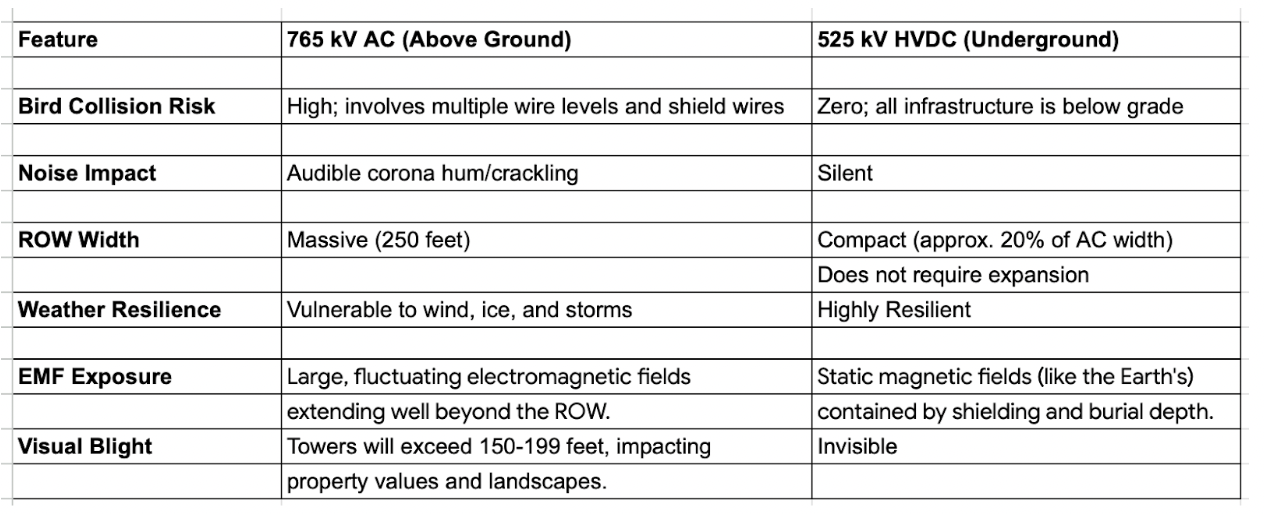
Comparison of above ground 765 kV AC transmission and underground 525 kV DC transmission
Demands for the Commission
The response points out that recent NextGen Highways legislation encourages the co-location of transmission lines within existing highway rights-of-way, a practice for which underground DC is uniquely suited.
Johnson has requested that the Commission stay the current proceedings and compel the applicants to submit a "good-faith" technical, economic, and environmental analysis of an underground 525 kV HVDC alternative before a Certificate of Need is granted.
The challenge to the Excel/Dairyland’s Certificate of Need Application can be found on the MN PUC’s website, HERE
